|
? ARE YOU A SAINT ?
"sanctified in each testament: old and new"
"I may not be a saint, but I wouldn't ever do that..." Have you ever heard a similar remark? What is a saint? According to the Bible? He is a sanctified person. Who were the saints at Corinth? 1 Corinthians 1:2.
The seventh day is the first
thing that God sanctified after creation. Eventually and historically other things
were sanctified by God.
REVIEW: The Seventh Day (Sabbath) IS not commanded nor is there any requirement associated with it thousands of years before Mt. Sinai's Law but is
the first "THING" in Scriptures that God
sanctified. God sanctified things under Moses that have nothing to do with us today. [For example, firstborn child, tabernacle furniture, objects, places, days, etc.]
[doubly or singularly click/tap the underlined word (in this case, sanctified) for definition table to appear].
Word: sanctified
Strongs: H6942
H6942
Mickelson's Enhanced Strong's Dictionaries of the Greek and Hebrew Testaments
H6942 qadash (kaw-dash') v.
1. to be clean (ceremonially or morally).
2. (causatively) to make, pronounce or observe as clean (ceremonially or morally).
[a primitive root]
KJV: appoint, bid, consecrate, dedicate, defile, hallow, (be, keep) holy(-er, place), keep, prepare, proclaim, qadash,purify, sanctify(-ied one, self), X wholly.
[?]
Lemma: |
Compare
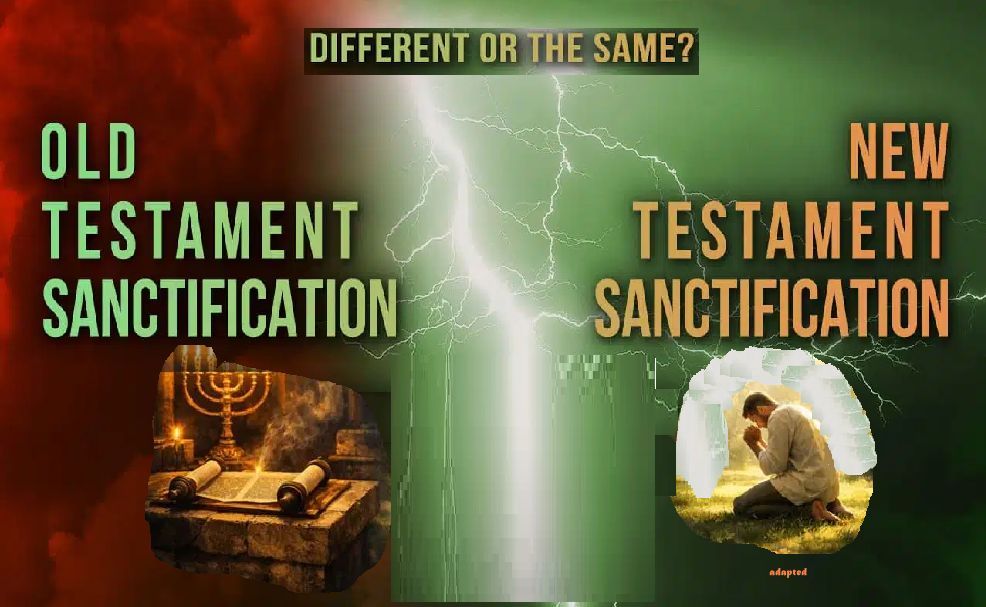
how sanctification differs between the Old and New Testaments.
Sanctification
in the Old Testament may be described primarily ritual and
positional, while in the New Testament it
becomes internal, moral, and Spirit-driven.
That’s the core difference — and the sources confirm
this.
1. What Sanctification Means
in Each Testament
A. Old Testament — “Set Apart”
(Formal/Ritual)
Root idea: qadash = to set apart,
consecrate, designate as belonging to God.
-
Anything can be sanctified: people, objects, places, days.
Sanctification is tied to ritual purity,
the Law, and external consecration.
OT sanctification is incomplete
because the sacrificial system is incomplete (Heb 10:1). It is not valid after the sacrifice of Jesus.
Hebrews 10: 1 "For the law [Law of Moses (OT)] having a shadow of good things to come, and not the very image of the things, can never with those sacrifices which they offered year by year continually make the comers thereunto perfect."
B. New
Testament — “Made Holy” (Internal/Ethical)
Root idea: hagiasmos / hagiazo = to make
holy, morally transform.
Sanctification becomes internal, ethical,
and spiritual.
Word: sanctified in Greek New Testament
Strongs: G37
G37
source:
Mickelson's Enhanced Strong's Dictionaries of the Greek and Hebrew Testaments
G37 hagiazo (ha-jiy-a'-zo) v.
1. to make holy, to set apart unto God and apart (alienate) from the world.
2. (ceremonially) to cleanse.
3. (mentally) to reverence.
[from G40]
KJV: hallow, be holy, sanctify
Root(s): G40
source:
Abbott-Smith's Manual Greek Lexicon of the New Testament
G37
Hellenistic form
to make holy, consecrate, sanctify;
[in LXX [Greek translation of OT} chiefly pi., hi.;]
1. to dedicate, separate, set apart for God; of things: Mat 23:17; Mat 23:19, 2Ti 2:21; of persons: Christ, Joh 10:36 Joh 17:19.
2. to purify, make conformable in character to such dedication: forensically, to free from guilt, 1Co 6:11, Eph 5:26, Heb 2:11 Heb 10:10; Heb 10:14; Heb 10:29 Heb 13:12; internally, by actual sanctification of life, Joh 17:17; Joh 17:19 Act 20:32 Act 26:18 Act 26:18. Rom 15:16, 1Co 1:2, 1Co 7:14, 1Th 5:23, Rev 22:11; of a non-believer influenced by marriage with a Christian, 1Co 7:14
3. In the intermediate sense of ceremonial or levitical purification:
(a) of things, 2Ti 2:21;
(b) of persons, Heb 9:13.
4. to treat as holy: Mat 6:9, Luk 11:2, 1Pe 3:15 (Cremer, 53, 602; MM, VGT, s.v.).
|
It is grounded in Christ’s once-for-all
sacrifice Heb 10: 9 Then said he, Lo, I come to do thy will, O God. He taketh away the first, that he may establish the second.
The sacrifice of Christ's body once offered
10 By the which will we are sanctified through the offering of the body of Jesus Christ once for all. Note: We receive from what Jesus has done for us.
The Holy Spirit regenerates, indwells,
seals, fills, and produces
fruit. E.g., 2 Thessalonians 2:13
"But we are bound to give thanks alway to God for you, brethren beloved of the Lord, because God hath from the beginning chosen you to salvation through sanctification of the Spirit and belief of the truth:"
-
1 Peter 1:2
"Elect according to the foreknowledge of God the Father, through sanctification of the Spirit, unto obedience and sprinkling of the blood of Jesus Christ: "
NT sanctification includes both positional holiness
(declared holy [sanctified] after being baptized -1 Cor. 6:11) and progressive holiness (becoming
holy). Ephesian 4: 13 "Till we all come in the unity of the faith, and of the knowledge of the Son of God, unto a
perfect man, unto the measure of the stature of the fulness of Christ:"
Word: perfect
Strongs: G5046
G5046
Mickelson's Enhanced Strong's Dictionaries of the Greek and Hebrew Testaments
G5046 teleios (te'-lei-os) adj.
complete.
{(neuter as noun, with G3588) completeness; in various applications of labor, growth, mental and moral character, etc.}
[from G5056]
KJV: of full age, man, perfect
Root(s): G5056
See also: G3588
Source:
Abbott-Smith's Manual Greek Lexicon of the New Testament
G5046
[in LXX chiefly for H8003 , H8549 and cogn. forms;]
having reached its end, finished, mature, complete, perfect;
1. of persons, primarily of physical development,
(a) full-grown, mature: Heb 5:14; ethically: Php 3:15; opp. to , 1Co 2:6; 1Co 14:20, Eph 4:13; t. , Col 4:12; t. ?? ???st?, Col 1:28;
(b) complete, perfect (expressing the simple idea of complete goodness, without reference either to maturity or to the philosophical idea of a ; v. Hort on Jas 1:4): Mat 5:48; Mat 19:21, Jas 1:4; Jas 3:2; of God, Mat 5:48.
2. Of things, complete, perfect: Rom 12:2; , Jas 1:4; ??µ??, Jas 1:25; , Jas 1:17; ???p?, 1Jn 4:18; t? t., 1Co 13:10; compar., , Heb 9:11.
(There is probably no reference in St. Paul's usage to the use of this term in the ancient mysteries; cf. ICC on Col 1:28; but v. also Lft., in l, and Notes, 173 f.)
SYN.: see G3648 * (and cf. Rendall, He., 158 ff.).
|
2. How Sanctification Operates
in Each Testament
A. Old Testament
External consecration: washing, anointing,
blood rituals.
Law-based holiness: holiness tied to
obedience to Mosaic commands.
Objects and places sanctified: tabernacle,
altar, garments, firstborn.
People sanctified by ritual: priests,
Levites, Israel as a nation.
Moral transformation is not the primary meaning;
holiness = belonging to Yahweh.
B. New Testament
Internal transformation: heart renewal, new
nature (2 Cor 5:17). 17 Therefore if any man be in Christ, he is a new creature: old things are passed away; behold, all things are become new. Spirit-driven holiness: fruit of the Spirit
Christ-centered sanctification: believers
sanctified “in Christ Jesus” (1 Cor 1:30). 30 But of him are ye in Christ Jesus, who of God is made unto us wisdom, and righteousness, and sanctification, and redemption:
Ethical emphasis: “This is the will
of God, your sanctification” (1 Thess 4:3).
Ongoing process: “You are sanctified…
now be sanctified” (Rom 6:19, 22). 22 But now being made free from sin, and become servants to God, ye have your fruit unto holiness[KJV], and the end everlasting life.
3. What Sanctification Requires
in Each Testament
A. Old Testament Requirements
Ritual purity
Sacrifices repeated continually
External separation from common things
Priestly mediation
Covenant obedience
Holiness is symbolic and ceremonial more
than moral
B. New Testament
Requirements
1 Peter 1:2 (KJV)
"Elect according to the foreknowledge of God the Father, through sanctification of the Spirit, unto obedience and sprinkling of the blood of Jesus Christ: Grace unto you, and peace, be multiplied."
Faith in Christ 1 Corinthians 1:30 (KJV)
"But of him are ye in Christ Jesus, who of God is made unto us wisdom, and righteousness, and sanctification, and redemption:"
Indwelling Holy Spirit
2 Thessalonians 2:13 (KJV)
"But we are bound to give thanks alway to God for you, brethren beloved of the Lord, because God hath from the beginning chosen you to salvation through sanctification of the Spirit and belief of the truth:"
Moral obedience motivated by God's grace 1 Thessalonians 4:3 (KJV)
"For this is the will of God, even your sanctification, that ye should abstain from fornication:"
Transformation of desires and character
1 Thessalonians 4:4 (KJV)
"That every one of you should know how to possess his vessel in sanctification and honour;"
Holiness [SANCTIFICATION] is ethical, spiritual, and relational 2 Thessalonians 2:13 (KJV)
"But we are bound to give thanks alway to God for you, brethren beloved of the Lord, because God hath from the beginning chosen you to salvation through sanctification of the Spirit and belief of the truth:"
4. The Role of the Holy Spirit
The Spirit does not indwell believers
permanently.
Sanctification is not described as
Spirit-driven.
Heart transformation is promised for the future
(Ezek 36:26).
OT sanctification is largely external.
B. New
Testament
The Spirit:
Regenerates (Titus 3:5) by the washing of regeneration, and renewing of the Holy Ghost
Word: regeneration
Strongs: G3824
Mickelson's Enhanced Strong's Dictionaries of the Greek and Hebrew Testaments
G3824 paliggenesia (pa-liyn-ge-ne-siy'-a) n.
1. (spiritually) regeneration (the state or the act).
2. (figuratively) spiritual renovation or rebirth.
3. (specially) Messianic restoration.
[from G3825 and G1078]
KJV: regeneration
Root(s): G3825, G1078
Compare: G342, G365, G605, G1357, G2676
Dictionary
Abbott-Smith's Manual Greek Lexicon of the New Testament
G3824
new birth, renewal, restoration, regeneration;
(a) of persons (Plut., Phil., al.), of spiritual regeneration, (gen. attr., v. Ellic., in l), Tit 3:5;
(b) of the world, as in Stoics, Jewish Apocal., al. (v. Dalman, Words, 177 ff.), Mat 19:28.†
|
Indwells (Rom 8:11) But if the Spirit of him that raised up Jesus from the dead dwell in you, he that raised up Christ from the dead shall also quicken your mortal bodies by his Spirit that dwelleth in you.
Word: dwelleth
Strongs: G1774
G1774
Mickelson's Enhanced Strong's Dictionaries of the Greek and Hebrew Testaments
G1774 enoikeo (en-oi-ke'-o) v.
to inhabit (figuratively).
[from G1722 and G3611]
KJV: dwell in
Root(s): G1722, G3611
Abbott-Smith's Manual Greek Lexicon of the New Testament
G1774
[in LXX chiefly (29/36) for H3427 ]
to dwell in; metaph., seq. , c. dat. pers: 2Cor 6:16; t. Rom 8:11, 2Timothy 1:14; , Col 3:16; , 2Timothy 1:5; Rom 7:17
|
Seals (Eph 1:13–14)
Fills (Eph 5:18)
Produces fruit (Gal 5:22–23)
Sanctification is impossible without the
Spirit.
NT sanctification is internal and external.
5. The Role of Sacrifice
Sacrifices symbolically sanctify.
They must be repeated.
They cannot perfect the conscience (Heb 10:1).
Sanctification is partial and anticipatory.
B. New
Testament
Christ’s sacrifice perfects and
completes sanctification.
“By one offering He has perfected forever those who
are sanctified” (Heb. 10:14).
Sanctification is rooted in the cross, not
ritual.
Believers are sanctified [made holy and saints) once for all (Heb
10:10; 1 Cor. 6:11).
6. Summary Table — OT vs NT
Sanctification
|
Feature
|
Old
Testament
|
New Testament
|
|
Meaning
|
Set apart,
consecrated
|
Made holy, morally transformed
|
|
Nature
|
External,
ritual
|
Internal, ethical, spiritual
|
|
Agent
|
Priests,
rituals
|
Holy Spirit
|
|
Basis
|
Mosaic Law
|
Christ’s sacrifice
|
|
Scope
|
People,
objects, days, places
|
Believers’ hearts and lives
|
|
Process
|
Repeated
rituals
|
Ongoing transformation
|
|
Goal
|
Ritual
purity, covenant identity
|
Christlikeness, moral holiness
|
Final Takeaway
OT sanctification is about
belonging to God
through ritual consecration.
NT sanctification is about
becoming like God
through the Spirit’s inner work.
But in both cases God does the sanctifying with man's positive response. For example, 1 Corinthians 6:11, "And such were some of you: but ye are washed, but ye are sanctified, but ye are justified in the name of the Lord Jesus, and by the Spirit of our God."
|