|
"what is sanctified under Moses?"
I am not a former pastor of the Sabbatarians. I am just a former student of their Voice of Prophecy correspondence course (from California) while a teenager growing up in western Tennessee during the fifties. I appreciated the correspondence study they offered to the public which I enrolled in and finished. I was fascinated expecially with their
interpretation of Old Testament and New Testament prophecies and their insistence of students memorizing Scripture and taking graded tests. And I found their local members cordial and friendly. A nice friendly family were members and good neighbors to my folks. So I do have an educated comprehension of their basic dogmas. I wish to share a few points that my later study indicated
those teachings differed from the Holy Scriptures.
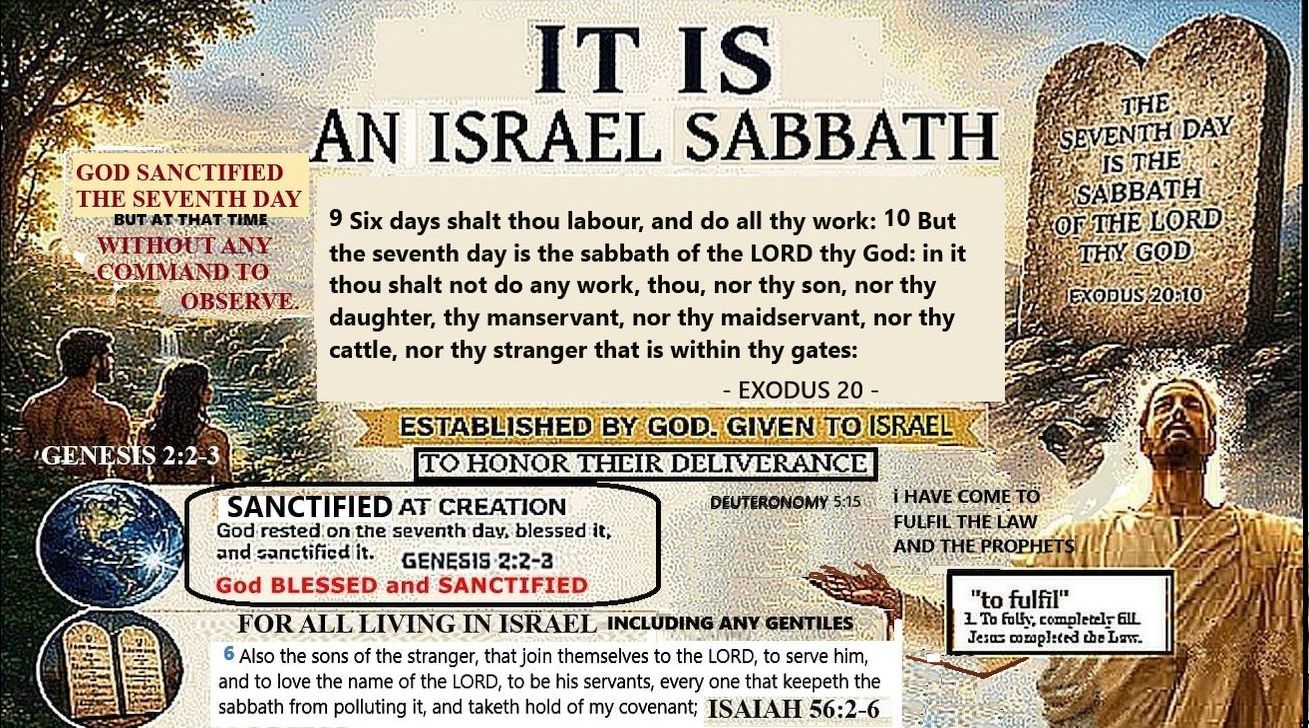
The seventh day is the first
thing that God sanctified after creation. Obviously, it is in the mind of God. However, no application is made initially to any man. Neither Adam nor Abraham is told to do anything with it. Finally after the flood and after Abraham and Joseph, a rescued people are taught how to observe and respect the seventh day.
Eventually and historically other things
were sanctified by God. This lesson is on God's sanctifying.
Below is a
structured breakdown with Scripture.
1. The Seventh Day (Sabbath) —
the first "THING" in Scriptures that God
sanctified*. *Note: please click/tap special underlined words for definition. Such words are defined when you click/tap the word. Twice to start with.
Word: sanctified
Strongs: H6942
H6942
Mickelson's Enhanced Strong's Dictionaries of the Greek and Hebrew Testaments
H6942 qadash (kaw-dash') v.
1. to be clean (ceremonially or morally).
2. (causatively) to make, pronounce or observe as clean (ceremonially or morally).
[a primitive root]
KJV translates this word also in other contexts as: appoint, bid, consecrate, dedicate, defile, hallow, (be, keep) holy(-er, place), keep, prepare, proclaim, purify, sanctify(-ied one, self), X wholly.
The KJV translates Strong's H6942 in the following manner: sanctify (108x), hallow (25x), dedicate (10x), holy (7x), prepare (7x), consecrate (5x), appointed (1x), bid (1x), purified (1x), miscellaneous (7x).
Brown-Driver-Briggs (Strong's):
1. to consecrate, sanctify, prepare, dedicate, be hallowed, be holy, be sanctified, be separate
a. (Qal)
1. to be set apart, be consecrated
2. to be hallowed
3. consecrated, tabooed
b. (Niphal)
1. to show oneself sacred or majestic
2. to be honoured, be treated as sacred
3. to be holy
c. (Piel)
a. to set apart as sacred, consecrate, dedicate
b. to observe as holy, keep sacred
c. to honour as sacred, hallow
d. to consecrate
d. (Pual)
1. to be consecrated
2. consecrated, dedicated
e. (Hiphil)
a. to set apart, devote, consecrate
b. to regard or treat as sacred or hallow
c. to consecrate
f. (Hithpael)
1. to keep oneself apart or separate
2. to cause Himself to be hallowed (of God)
3. to be observed as holy
4. to consecrate oneself
|
Genesis 2: 2 "And on the seventh day God ended his work which he had made; and he rested on the seventh day from all his work which he had made. 3 And God blessed the seventh day, and sanctified it: because that in it he had rested from all his work which God created and made."
rested
Word: rested
Strongs: H7673
H7673
Mickelson's Enhanced Strong's Dictionaries of the Greek and Hebrew Testaments
H7673 shabath (shaw- ath') v.
to repose, i.e. to cease from exertion.
{used in many implied relations (causative, figurative or specific)}
[a primitive root]
KJV also translates in other places: (cause to, let, make to) cease, celebrate, cause (make) to fail, keep (sabbath), suffer to be lacking, leave, put away (down), (make to) rest, rid, still, take away.
|
work
Word: work
Strongs: H4399
H4399
Mickelson's Enhanced Strong's Dictionaries of the Greek and Hebrew Testaments
H4399 mla'kah (mel-aw-kaw') n-f.
1. (properly) deputyship (i.e. ministry).
2. (generally) occupation, employment (never servile).
3. (abstractly or concretely) work.
4. (as the result of labor) property.
[from the same as H4397]
KJV translates it also in other places as: business, + cattle, + industrious, occupation, (+ -pied), + officer, thing (made), use, (manner of) work((-man), -manship).
Root(s): H4397
Compare: H4639
|
[doubly or singularly click/tap the underlined word (e.g., sanctified) for definition table]. Then once to hide it.
Genesis 2:3 — “God blessed
the seventh day and sanctified
it…” This is the earliest sanctification in
Scripture. A chief point for our digest is that this is an action that is made by God for Himself. Man is yet not involved. The verb indicates an action by God and not yet a command.
Understanding this is important since so much is made and doctrinal assumptions made with this verse.
| Deuteronomy 5:32 (KJV)
"Ye shall observe to do therefore as the LORD your God hath commanded you: ye shall not turn aside to the right hand or to the left." |
Genesis 2:3 says God sanctified the seventh day, meaning He set it apart as His special day. But the text does not say:
Adam was commanded to keep it; nor,
Adam and Eve observed it; nor,
Cain, Abel, Seth, Enoch, Noah, or anyone else kept it; nor,
any pre-Flood society recognized it; nor,
any Gentile nation adopted it.
Genesis 2 describes God's action, not human obligation.
2. Later, God sanctifies a certain PEOPLE
God sanctifies His people in both Old and New Testaments — Israel, priests, and
believers.
Exodus 31:13 — God says the Sabbath
is a sign “that you may know that I am the LORD who
sanctifies you (Israel).” God sanctified Israel.
Leviticus 20:7–8 — God says He
sanctifies Israel.
Leviticus 21:8 — God sanctifies the
priesthood in Israel.
John 17:17, New Testament — Jesus prays for God to-- “Sanctify
THEM through Thy truth.”
1 Thessalonians 5:23 — God sanctifies New Testament
believers through His Word ("Thy Word is Tr;uth").
Conclusion: God sanctifies certain people,
not just a day.
3. God also sanctified OBJECTS
Several physical items are explicitly said to be sanctified or
made holy by the people:
4. God sanctified TIMES in addition to the
seventh day
The Mosaic feasts and holy convocations are repeatedly called
holy or sanctified days.
Leviticus 23 lists multiple sanctified days that are His
convocations *:
verse 4 These are the feasts of the LORD, even holy convocations,*
which ye shall proclaim in their seasons. * For the definition of the term convocations, click/tap doubly on the word underlined. [Notice it has a similar meaning to "church" in New Testament.-GW]
CONVOCATION Strongs: H4744
convocation H4744
Mickelson's Enhanced Strong's Dictionaries of the Greek and Hebrew Testaments
H4744 miqra' (mik-raw') n-m.
1. something called out, i.e. regarding citizens (the act of, the persons, or the place).
2. a calling forth (of the congregation) to assemble.
3. (as an event, with H6944) a (holy) called out memorial (i.e. a recalling to collective memory; the appointed feasts; see Leviticus 23:2).
4. (specially) a called out assembly (of the Redeemed Kinsmen of Yahweh-out of captivity; see Nehemiah 8:8, then Exodus 6:6, Exodus 15:13).
5. (specifically, of Yeshua) a called out assembly of the Redeemed of Yeshua (Jesus), both of Jew (first) and of Gentile- from Moral Failure and
Death (see progression from Isaiah 4:5, Matthew 18:17, Matthew 16:18, Acts 2:47).
6. (Note #1) (The called out assembly is the citizenry of the Redeemed of Jesus; the citizenry under his Redemption and Kingship; Although identified regionally,
the citizens of Redemption differs by nature from a local gathering, synagogue, congregation, or the institution of church. "What redemption do you belong to?").
7. (Note #2) From Matthew 16:18, Yeshua said, "I will build, my called out assembly." When residing upon mount Tsiyon (Zion), it is figuratively called",
her called out assembly" in Isaiah 4:5. Aside from this, it is never personalized by anyone else in Scripture; we belong to him.
[from H7121]
KJV: assembly, calling, convocation, reading.
Root(s): H7121
See also: G1577
GREEK WORD IN OT SEPTUAGINE VERSION (used by apostles in NT):
Strongs: G2822
Mickelson's Enhanced Strong's Dictionaries of the Greek and Hebrew Testaments
G2822 kletos (klee-tos') adj.
1. called.
2. (specially, divinely) called forth.
3. (figuratively) invited.
4. (specially) a person redeemed by Jesus (i.e. the called of Christ, the Annointed One).
5. (Hebraically, as an event) a (holy) called out memorial (i.e. a recalling to collective memory; the appointed feasts).
[from a shorter form of G2564]
KJV: called
Root(s): G2564
See also: G2821, G1577, H4744
|
Sabbath v.1 And the LORD spake unto Moses, saying, 2 Speak unto the children of Israel, and say unto them, Concerning the feasts of the LORD, which ye shall proclaim to be holy convocations [assemblies], even these are my feasts.
3 Six days shall work be done: but the seventh day is the sabbath of rest, an holy convocation; ye shall do no work therein: it is the sabbath of the LORD in all your dwellings.
Passover --v. 4 These are the feasts of the LORD, even holy convocations, which ye shall proclaim in their seasons.
Feast of Unleavened Bread v. 7 In the first day ye shall have an holy convocation: ye shall do no servile work therein. 8 But ye shall offer an offering made by fire unto the LORD seven days: in the seventh day is an holy convocation: ye shall do no servile work therein.
Feast of Weeks v. 10 Speak unto the children of Israel, and say unto them, When ye be come into the land which I give unto you, and shall reap the harvest thereof, then ye shall bring a sheaf of the firstfruits of your harvest unto the priest:1 11 And he shall wave the sheaf before the LORD, to be accepted for you: on the morrow after the sabbath the priest shall wave it. 12 And ye shall offer that day when ye wave the sheaf an he lamb without blemish of the first year for a burnt offering unto the LORD
Feast of Trumpets24 Speak unto the children of Israel, saying, In the seventh month, in the first day of the month, shall ye have a sabbath, a memorial of blowing of trumpets, an holy convocation.
Day of Atonement v. 27 Also on the tenth day of this seventh month there shall be a day of atonement: it shall be an holy convocation unto you; and ye shall afflict your souls, and offer an offering made by fire unto the LORD.
Feast of Tabernacles v. 34 Speak unto the children of Israel, saying, The fifteenth day of this seventh month shall be the feast of tabernacles for seven days unto the LORD. 35 On the first day shall be an holy convocation: ye shall do no servile work therein.
These are called “holy convocations” (Notice that even the seventh day is a convocation day
—and such a convocation day for each family is set apart by God. [See and tap on the word convocations above for both Hebrew and Greek meanings. Compare it to the New Testament word "church."]
While the text often uses “holy” rather than
“sanctified,” the Hebrew concept (qadash) is
the same root idea: set apart.
5. God required the sanctification of the firstborn in Israel.
6. God sanctified Mount Sinai
7. God sanctified Jesus (the Son) in the New Testament
Summary Table
-
|
Category
|
Sanctified by God?
|
Examples
|
|
Day
|
✔
Yes
|
Seventh
day (Gen 2:3)
|
|
People
|
✔
Yes
|
Israel,
priests, believers (Lev 20:7–8; (in NT: John 17:17)
|
|
Objects
|
✔
Yes
|
Tabernacle,
altar, garments (Ex 40:9–13; Ex 29:36–37)
|
|
Other Times
|
✔
Yes
|
Holy
convocations/feasts (Lev 23)
|
|
Firstborn
|
✔
Yes
|
Exodus
13:2
|
|
Places
|
✔
Yes
|
Mount
Sinai (Ex 19:23)
|
|
Jesus
|
✔
Yes
|
John 10:36
|
Final Answer
The seventh
day is the first thing God sanctified in the Old Testament, but Scripture shows God
sanctifying people, objects, places, the firstborn, and
other holy days as well. Consider this point: God's sanctifying does not tell us how or what to do with it (e.g., Mark 10:3). For example, "the firstborn" is sanctified. The writings of Moses explain who, what and how to treat all holy (SANCTIFIED) items.
|