I am not a former pastor of the Sabbatarians. I am just a former student of their Voice of Prophecy correspondence course (from California) while a teenager growing up in western Tennessee. I appreciated the correspondence study they offered to the public which I enrolled in and finished. I was fascinated expecially with their interpretation of Old Testament and New Testament prophecies and their insistence of students memorizing Scripture and taking graded tests. And I found their local members cordial and friendly. A nice friendly family were good neighbors to my folks. So I do have an educated comprehension of their basic dogmas. I wish to share a few points that my later study indicated their teachings differing from the Holy Scriptures.
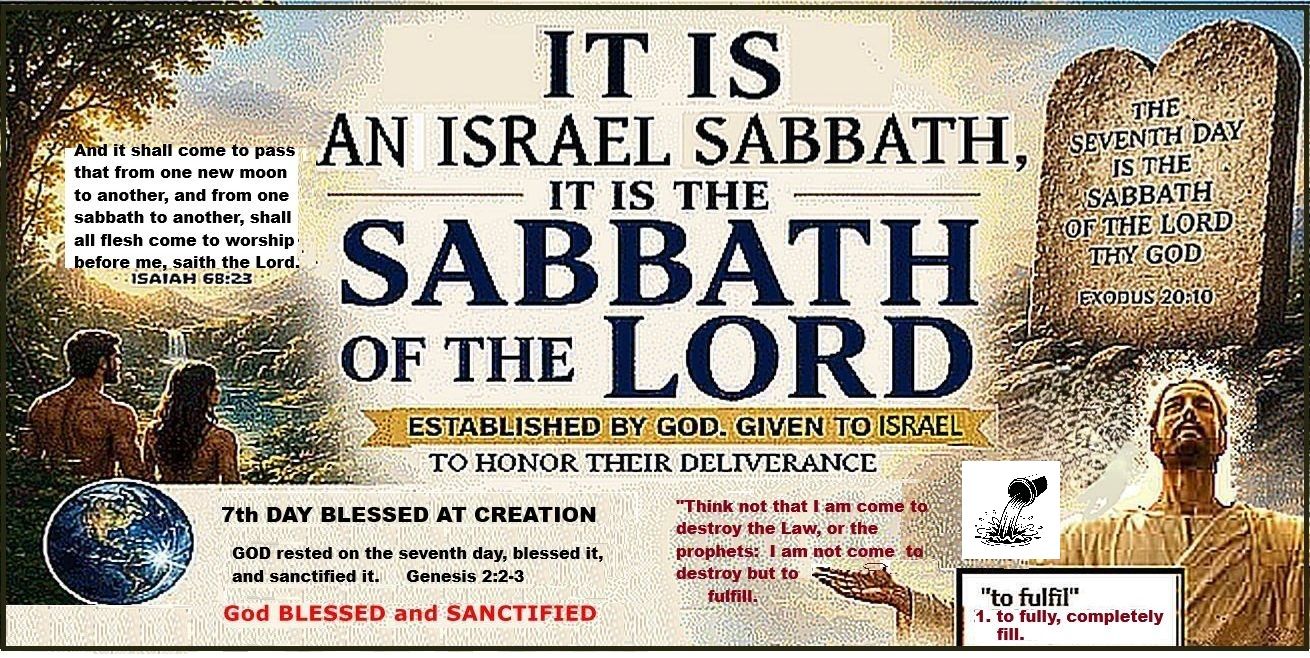
GOD BLESSED THE SEVENTH DAY AT THE BEGINNING and this is true according to Genesis 2.
Genesis 2: 2 And on the seventhH7637 day God ended his work which he had made; and he rested on the seventhH7637 day from all his work which he had made. 3 And God blessedH1288 the seventh day, and sanctifiedH6942 it: because that in it he had rested from all his work which God created and made.
FOR THE MEANING OF BASIC numbered WORDS IN THE above Bible TEXT click/tap on each underlined word:
* Word: seventh Strongs # H7637 (Click/ tap for chart .)
|
H7637 Mickelson's Enhanced Strong's Dictionaries of the Greek and Hebrew Testaments
H7637 שְׁבִיעִי shbiy`iy (sheɓ-ee-ee') adj. שְׁבִעִי shbi`iy (sheɓ-ee-ee') 1. seventh. 2. seven. [ordinal from H7651] KJV: seventh (time). Root(s): H7651
|
Word: blessed Strongs # H1288 (Click/ tap for chart .)
|
"blessed" in Hebrew H1288 Mickelson's Enhanced Strong's Dictionaries of the Greek and Hebrew Testaments H1288 בָּרַךְ barak (baw-rak') v. 1. to kneel. 2. (implication, man toward God) to bless God as an act of adoration. 3. (implication, God toward man) to bless man as a benefit. 4. (by euphemism) to curse (God or the king, as treason). [a primitive root]
KJV: [translated as]
X abundantly, X altogether, X at all, blaspheme, bless, congratulate,
curse, X greatly, X indeed, kneel (down), praise, salute, X still,
thank. |
Word: sanctified Strongs # H6942 ( Click/ tap for chart .)
|
H6942 Mickelson's Enhanced Strong's Dictionaries of the Greek and Hebrew Testaments
H6942 קָדַשׁ qadash (kaw-dash') v. 1. to be clean (ceremonially or morally). 2. (causatively) to make, pronounce or observe as clean (ceremonially or morally). [a primitive root] KJV: [translated as] appoint, bid, consecrate, dedicate, defile, hallow, (be, keep) holy(-er, place), keep, prepare, proclaim, purify, sanctify(-ied one, self), X wholly. |
Does this mean God commanded a sabbath day observance by Adam and/or all people including the Gentiles?
My initial point would be that such is a fabrication and assumption that is not in the text. To bless does not mean to command. The passage tells us what God does; just like Genesis 1:1. And no one that I know argues that we are bound to observe or celebrate religiously a creation day. No, this behavior of God is noted by the writer for
our information that will be repeated later in the Pentateuch and used for a particular purpose. But not in the Genesis history though.
Secondly, and this is a fact: there is no Biblical or empirical evidence of either the requirement of observing a sabbath or anyone observing such. The Bible does not mention or use even the word "sabbath" in Genesis before or after the flood relative to man's activities.
Although there is no mention of the man's activity of "sabbath" in the Bible's Genesis, a 7-day period is referred to several times (Genesis 7:4,10; 8:10,12; 29:27 f). But no "sabbath." The first express mention of the Sabbath is only found with Israel in Exodus 16:21-30 in connection with the giving and collection of the manna from heaven.* To prepare for the rest is apparently a new practice since the people have to learn to remember to observe it. *[--www.internationalstandardbible.com/S/sabbath.html]
e.g., Exodus 16:23 "And he said unto them, This is that which the LORD hath said, To morrow is the rest of the holy sabbath unto the LORD: bake that which ye will bake to day, and seethe that ye will seethe; and that which remaineth over lay up for you to be kept until the morning.
29 See, for that the LORD hath given you [Israel, not mankind] the sabbath, therefore he giveth you on the sixth day the bread of two days; abide ye every man in his place, let no man go out of his place on the seventh day. "
That the Sabbath was not a practice of Israel until after the Exodus is made plain from the references of Deuteronomy 5:2, 3 and Exodus 31:16, 17: "It was not with our forefathers that Jehovah concluded this covenant, but with us." "The sons of Israel must keep the sabbath . . . during their generations. . . . Between me and the sons of Israel it is a sign to time indefinite." If Israel had already been observing the Sabbath, it could not have served as a reminder of their deliverance from Egypt by Jehovah, as shown at Deuteronomy 5:15. The fact that some of the Israelites went out to pick up manna on the seventh day, in spite of direct instruction to the contrary, indicates that Sabbath observance was something new! (Exodus 16:11-30) [these points are made in https://www.jw.org/en/library/books/Insight-on-the-Scriptures/Sabbath-Day]
INVESTIGATING GENTILE HISTORY for evidence of sabbath observance. The first legal codes of history give us clues for what was a common feature of the systems and customs in the ancient Middle East. Many of them are examples in and of cuneiform law. The oldest evidence of a code of law was found at Ebla, in modern Syria (c. 2400 BC). And then there was the Sumerian Code of Ur-Nammu (c. 2100-2050 BC). Then the Babylonian Code of Hammurabi (c. 1760 BC) are amongst the earliest and originated in the Fertile Crescent. [ en.wikipedia.org/wiki/List_of_ancient_legal_codes] Government and law in the ancient world encompassed diverse systems, each reflecting their unique societal structures. In Mesopotamia, for example, the Code of Hammurabi established one of the earliest written legal codes, regulating social interactions. [ .www.ebsco.com/research-starters/law/government-and-law-ancient-world ] There is no mention of a sabbath observance. This absence before the giving of the Mosaic Law is overwhelming. The Code of Hammurabi contains 282 laws, but not a word of observing any sabbath for any reason.
Abraham, the father of nations, is not reported to have observed a sabbath. But Abraham and Sarah make a judgment based on their social norms contrary to God's authority. Abraham and Sarah's use of Hagar as a surrogate fits a well-established legal and social pattern in the ancient Near East, explicitly authorized and regulated in the Code of Hammurabi--Laws #144-147--understood to be a contemporary of Abraham. But there's nothing in that code to indicate any practice of a sabbath. The biblical narrative reflects the same social and legal norms found in Gentile Mesopotamian law.
Jonah, in about 700 years after the giving of the Law to Israel at Sinai, is commissioned to go and preach to the Gentiles in Nineveh, Assyria. Jonah 1:2 "Arise, go to Nineveh, that great city, and cry against it; for their wickedness is come up before me." The sermon delivered to the city speaking of God destroying them, never mentions the sabbath day being violated. But they are accused of being wicked.
These Gentiles were doing evil and violence. They were not chastised for failing to observe any sabbath. Jonah 3:7-9, "...the king and his nobles, saying, Let neither ... taste any thing: let them not feed, nor drink water: 8 But let man and beast be covered with sackcloth, and cry mightily unto God: yea, let them turn every one from his evil way, and from the violence that is in their hands. 9 Who can tell if God will turn and repent, and turn away from his fierce anger, that we perish not?"
God sees their response and cancels their destruction. The condemnation of these Gentiles had nothing to do with any sabbath and they are not required to start observing it. Jonah 3:10 " And God saw their works, that they turned from their evil way; and God repented of the evil, that he had said that he would do unto them; and he did it not."
THE SABBATH WAS LIMITED: IN SCOPE AND OBSERVANCE
My point is that the sabbath was not an universal law from the time that God blessed the seventh day. It was not called a sabbath from the beginning. The Gentiles, which would include everybody to start with, were never expected to observe it. When the blessing and thanks are said for meals, the Lord does not interpret it to be a command.
The sabbath actually was assigned for Israel only for the appointed limited time (throughout their generations). Exodus 31:13 (KJV) "Speak thou also unto the children of Israel, saying, Verily my sabbaths ye shall keep: for it is a sign between me and you throughout your generations; that ye may know that I am the LORD that doth sanctify you."
Ezekiel 20: 12 "Moreover also I gave them [Israel] my sabbaths, to be a sign H226 between me and them."
SIGN H226 (Double click the word "sign" for its definition table.)
|
Word: sign Strongs: H226 H226 Mickelson's Enhanced Strong's Dictionaries of the Greek and Hebrew Testaments H226 - a signal (literally or figuratively), as a flag, beacon, monument, omen, prodigy, evidence, etc. [probably from H225 (in the sense of appearing)] KJV: mark, miracle, (en-)sign, token. Root(s): H225 |
If Adam and Eve or their children were never known for observing a sabbath nor were our Gentile ancestors then we ask why does anyone have the right to say that the sabbath is an eternal law for all men?
On the other hand, when Israel sins, it often includes the violation of the sabbath. For example, Ezekiel 20:16 (KJV) "Because they despised my judgments, and walked not in my statutes, but polluted my sabbaths: for their heart went after their idols."
STRICTLY A SIGN. It is designated strictly as a sign between God and Israel. Ezekiel 20:19, "I am the LORD your God; walk in my statutes, and keep my judgments, and do them; 20 And hallow my sabbaths; and they shall be a sign between me and you, that ye may know that I am the LORD your God." Please note that the sabbath was a sign between gOD and Israel.
Why was the nation of Israel given the sabbath command? There are two passages given for the sabbath day commandment being given to Israel in the "Ten Commandments" list delivered to the children of Israel from God through Moses.
FIRST passage: Exodus 20: 8 "Remember the sabbath day, to keep it holy. (GW:HOW WAS THIS TO BE DONE?) 9 Six days shalt thou labour, and do all thy work: 10 But the seventh day is the sabbath of the LORD thy God: in it thou shalt not do any work, thou, nor thy son, nor thy daughter, thy manservant, nor thy maidservant, nor thy cattle, nor thy stranger that is within thy gates: ( GW: WHY the SEVENTH DAY?) 11 For in six days the LORD made heaven and earth, the sea, and all that in them is, and rested the seventh day: wherefore the LORD blessed the sabbath day, and hallowed it."
SECOND passage: Rehersal of the ten commandments. Deuteronomy 5: 12 "Keep the sabbath day to sanctify it, as the LORD thy God hath commanded thee. (GW:HOW WAS THIS TO BE DONE?)13 Six days thou shalt labour, and do all thy work: 14 But the seventh day is the sabbath of the LORD thy God: in it thou shalt not do any work, thou, nor thy son, nor thy daughter, nor thy manservant, nor thy maidservant, nor thine ox, nor thine ass,
nor any of thy cattle, nor thy stranger that is within thy gates; that thy manservant and thy maidservant may rest as well as thou.
( GW: (WHY KEEP THIS COMMANDMENT?) 15 And remember that thou wast a servant in the land of Egypt, and that the LORD thy God brought thee out thence through a mighty hand and by a stretched out arm: therefore the LORD thy God commanded thee to keep the sabbath day."
Conclusion: There is no sabbath command given to anyone in Genesis and no mention of any observance of a sabbath. But in Exodus it is added for a particular people for a particular reason.
This is as late as around the fifteenth century BC. That's only about 3500 years ago. And it is noteworthy that a specific society (i.e.,the people of Israel) delivered from Egyptian slavery was so commanded.
Moses declares that this covenant that has the sabbath command was unique to rescued Israel:
Deuteronomy 5:3 "The LORD made not this covenant *H1285 [which has the sabbath command) "with our fathers, but with us, even us, who are all of us here alive this day."
Historically, then, we must conclude that the sabbath command was unique in its observance and in its participants. *covenant H1285 (click/tap for definition table.)
And
Nehemiah 9:14 (KJV) reminds Bible readers that the sabbath was not known until Moses and hence, Mt. Sinai and giving of the Ten Commandments:
"And madest known unto them thy holy sabbath, and commandedst them precepts, statutes, and laws, by the hand of Moses thy servant."
Let's now look at the expression in Genesis 2:2, "God sanctified the seventh day." What does that mean?Word: covenant
Strongs: H1285
Mickelson's Enhanced
Strong's
H1285 briyth (ber-eeth') n-f.
a compact (because made by passing between pieces of flesh).
[from H1262 (in the sense of cutting (like H1254))]
KJV: confederacy, (con-)feder(-ate), covenant, league.
Root(s): H1262, H1254