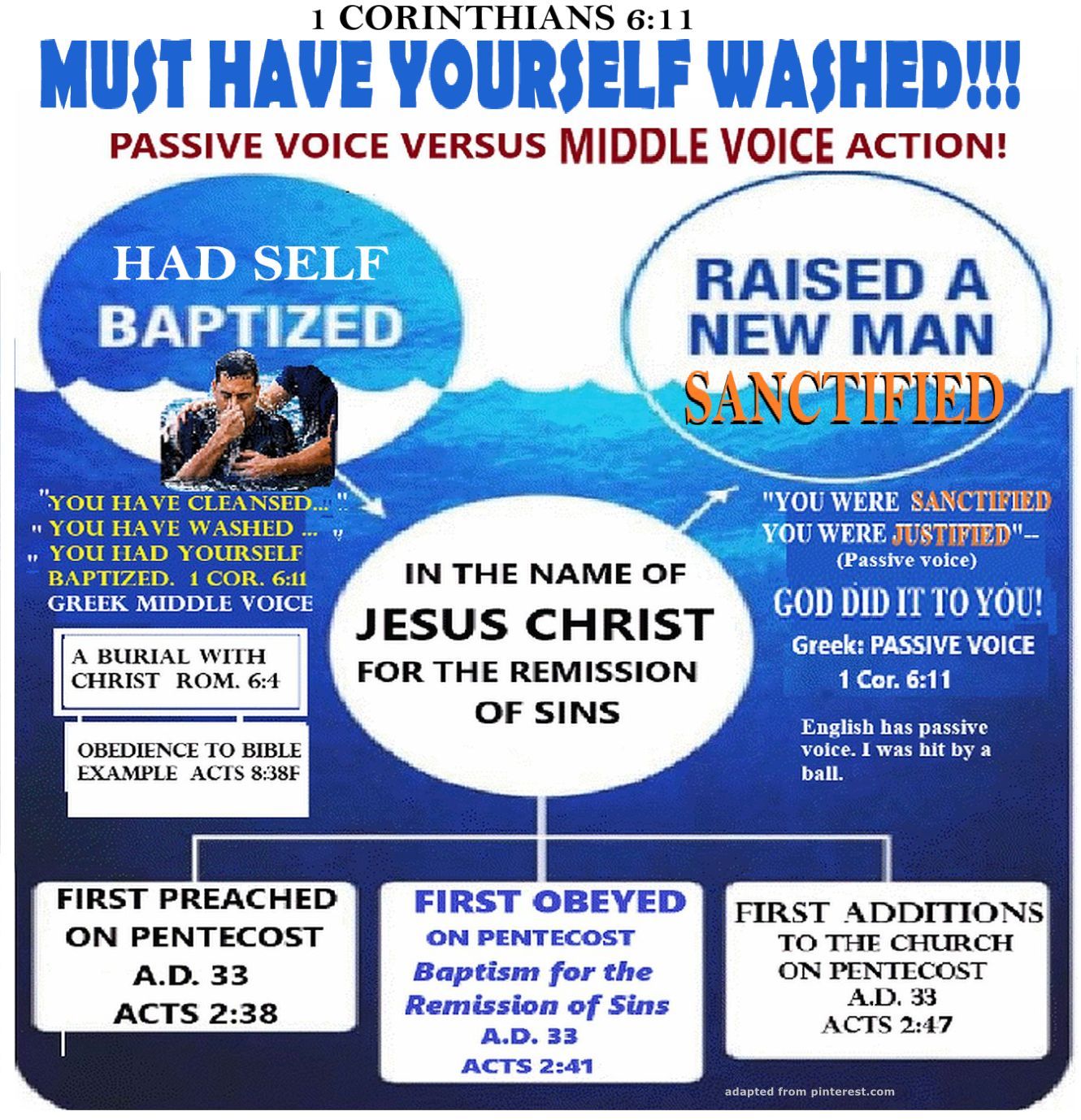
| 1 Corinthians 6:9 "Know ye not that the unrighteous shall not inherit the kingdom of God? Be not deceived: neither fornicators, nor idolaters, nor adulterers, nor effeminate, nor abusers of themselves with mankind, 10 Nor thieves, nor covetous, nor drunkards, nor revilers, nor extortioners, shall inherit the kingdom of God. 11 And such were some of you: but ye are washed, but ye are sanctified, but ye are justified in the name of the Lord Jesus, and by the Spirit of our God." 3 things have happened to the Corinthian "saints" (1 Corinthians 1:1-5) |
YOU HAVE TO DO SOMETHING TO BECOME A SAINT!
(Original) Greek Middle voice = "the subject participates in the action affecting oneself." note: English has only 2 verb voices: active and passive: active (doing something; e.g., "hit the ball"); passive (something being done to you; e.g., "was hit by the ball"). 1 Corinthians 6:11's original Greek language includes "the middle voice" for the action which requires the subject's action. His own action! (e.g., "hit himself with a ball").
Consider, THE NEW BIRTH THAT JESUS SPOKE OF IN JOHN 3 speaks of one being born of water. Denominations' refuse to accept Jesus statement of "water" being a physical part of the "birth from above" in John 3 contradict not only Jesus in John 3 but also Paul's teaching (from the Spirit) in 1 Corinthians 6:11.
For example, Across Baptist traditions--Southern Baptist, Reformed Baptist, Primitive Baptist, Independent Baptist--the dominant interpretation is: "Water" in John 3:5 is not physical birth, but a spiritual metaphor connected to the Spirit's cleansing and renewing work. This view is supported by the Baptist argument: contextual repetition in John 3. Jesus restates the new birth multiple times: "born again" (v.3) "born of water and the Spirit" (v.5) "born of the Spirit" (v.6, v.8) The later restatements drop the word "water," showing that "water and Spirit" is a unified idea--not two births. -from AI CoPilot.
No one interprets the "born again" as two new births if this is what was meant in the above. This would be a straw man fallacious argument. The first singular "born again" separate and apart from the others would not negate the explanatory part of the Spirit either. All of this in order to prop up their argument in refusing the New Testament's teaching of water baptism command of such as Acts 2:38, etc.
Obviously, the Spirit's preaching through Peter and apostles on the day of Pentecost (Acts 2) and the additions to the church throughout the book of Acts is ignored. This ignores also the examples of people of faith obediently being baptized in water throughout the book of Acts.
People born "from above" (born again, KJV) are saints (holy, sanctified persons). They have been sanctified (made holy) by God. 1 Corinthians "sanctification text" shows us that there are at least a two actions in the new birth. First, the person has to do something to himself but is covered by Jesus and the Spirit of God. From 1 Corinthians 6:11, lexicon: “Such were some of you [sinners]; but you were washed [middle voice, requiring the active participation], but you were sanctified [passive], but you were justified [passive] in the name [authority] of the Lord Jesus Christ and in the Spirit of our God.” God's authority of the action of washing assures God's participation.
+The Complete Jewish Bible translation accentuates the middle action translation in spite of it using "cleansed"* [striking activates definition below) instead of the KJV word "washing": [click on underlined word/s for Greek definition appearing below.] 1 Corinthians 6: 11, “Some of you used to do these things. But you have cleansed [striking makes definition appear below] yourselves, you have been set apart for God, you have come to be counted righteous through the power of the Lord Yeshua the Messiah and the Spirit of our God." https://biblehub.com/lexicon/1_corinthians/6-11.htm references: 1 Corinthians 6:11 -
Bíblia Plus |
*"cleansed" [click on underlined word/s for Greek definition.]
|
Word: washed Strong's: G628 G628 Mickelson's Enhanced Strong's Dictionaries of the Greek and Hebrew Testaments G628 apolouo (a-po-lou'-o) v. 1. to bathe fully. 2. (figuratively) have remitted (reflexively). [from G575 and G3068] KJV: wash (away) Root(s): G575, G3068 Abbott-Smith's Manual Greek Lexicon of the New Testament G628 [in LXX: Job 9:30 (H7364 ;] to wash off, wash away; mid., metaph., c. acc rei, to wash off oneself: Acts 22:16; absol., , ye washed yourselves clean (cf. Cremer, 406), 1Co 6:11.† |
In 1 Corinthians 6:11, the Holy Spirit through the apostle Paul uses two different Greek voices to describe two distinct kinds of action for the words "washed" on the one hand and the last two actions, "sanctified" and "justified" on the other. ":
“Washed” — ἀπελούσασθε (aorist middle indicative): You yourselves participated in the action (middle voice). It describes a deliberate, personal turning from the old life—expressed in baptism and repentance.
“Sanctified” — ἡγιάσθητε (aorist passive indicative): God acted upon you (passive voice). It describes the divine consecration that set you apart as holy.
Below is a deeper, structured explanation.
1. “Washed” — ἀπελούσασθε (aorist middle indicative)
Greek Middle voice = “the subject participates in the action affecting itself.”
Meaning:
“You washed yourselves,” or “you allowed yourselves to be washed.”
The verb points to your own initiative in responding to God—turning from sin, submitting to baptism,
Commentators note that the middle voice highlights the Corinthians’ deliberate break with their former life. But it is in the act of baptism in water (Acts 2:38; Romans 6:4).
2. “Sanctified” — ἡγιάσθητε (aorist passive indicative);
Important: what is said for "sanctified" applies to its compound verb "justified."Passive voice = the subject receives the action from another.
Meaning:
“You were sanctified,” i.e., God made you holy, consecrated you, set you apart.
This is God’s action, not yours.
The passive voice emphasizes divine initiative: God is the one who performs sanctification and justification to accompany the washing.
Summary of the difference
|
Verb |
Greek |
Voice |
Who acts? |
What it describes |
|---|---|---|---|---|
|
Washed |
ἀπελούσασθε |
Middle |
You acted (in response to God)* |
Your turning from sin; baptismal cleansing |
|
Sanctified |
ἡγιάσθητε |
Passive |
God acted upon you |
God’s consecration, making you holy |
*baptism requires a third person to “dip” you
as Biblical examples show as well as Jesus' command to His disciples to "baptize" (Matthew 28:19). You participate in being baptized or buried in water.Romans 6:3-5, KJV “ Know ye not, that so many of us as were baptized into Jesus Christ were baptized into his death? Therefore we are buried with him by baptism into death: that like as Christ was raised up from the dead by the glory of the Father, even so we also should walk in newness of life. 5 For if we have been planted together in the likeness of his death, we shall be also in the likeness of his resurrection: “
Summation:
Paul intentionally uses middle → passive → passive to show:
Your response (“you washed yourselves”).
God’s transforming work (“you were sanctified”).
God’s legal declaration (“you were justified”).
Paul uses the Greek aorist for all three verbs in 1 Corinthians 6:11 which describe decisive, once for all actions that mark the believer’s break with the old life and entrance into the new.
The voice of each verb shows who performed the action, and the aorist tense shows the action’s completeness.
Now let’s break down each verb in 1 Corinthians 6:11 with precision.
1. “Washed” — ἀπελούσασθε (aorist middle indicative)
Aorist meaning
The aorist tense presents the action as a single, complete event. Paul is pointing to a decisive moment in the Corinthians’ past when they broke with their former lifestyle.
Why aorist + middle?
Middle voice: you yourselves participated in the action.
Aorist tense: you did this decisively at a point in time.
This fits perfectly with:
conversion,
repentance,
baptismal cleansing, as a once for all turning.
Paul is not describing an ongoing washing. He is pointing to the moment they left their old identity behind.
2. “Sanctified” — ἡγιάσθητε (aorist passive indicative)
Aorist meaning
Again, a completed action in the past. This is not progressive sanctification (the lifelong growth). This is positional sanctification — the moment God set them apart as His holy people. Every Chrisitian is a saint. God made you so.
Why aorist + passive?
Passive voice: God acted upon you.
Aorist tense: He did this decisively at conversion.
Paul is saying:
“At the moment you came to Christ, God consecrated you — once, definitively.”
This is why sanctification is placed before justification in the verse: Paul is describing the identity change, not the lifelong process.
⚖️ 3. “Justified” — ἐδικαιώθητε (aorist passive indicative)
Aorist meaning
Justification is also a completed, once for all act. God declared them righteous at a definite moment.
Why aorist + passive?
Passive voice: God is the one who justifies.
Aorist tense: He did it once, not repeatedly.
Paul is emphasizing:
“Your legal standing before God was settled at conversion.”
Why Paul uses aorist for all three
Paul is building a three part snapshot of the Corinthians’ past:
You responded (washed — middle).
God consecrated you (sanctified — passive).
God declared you righteous (justified — passive).
All three are:
aorist → completed, decisive, identity defining acts
indicative → real historical events
conversion anchored → marking the break with the old life listed in vv. 9–10
Paul’s point is pastoral and theological:
“You are no longer what you were. A decisive change has already happened — you acted, and God acted upon you.” This is Paul's argument for their new life and living.
Final synthesis
The voices show who acted. The aorists show how completely the actions were done. Together they form one of Paul’s clearest statements of the believer’s new identity.
Titus 3:5 5 “Not by works of righteousness which we have done, but according to his mercy he saved us, by the washing of regeneration, and renewing of the Holy Ghost; “
Hebrews 10:10. 9 “Then said he, Lo, I come to do thy will, O God. He taketh away the first [the “law” or covenant], that he may establish the second. 10 By the which “will” [or covenant] we are sanctified through the offering of the body of Jesus Christ once for all.”