1
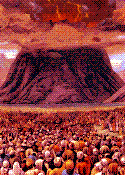 "He added no more."
1
"He added no more."
|
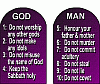 The 10 commandments were written by God on two tables of stone.
3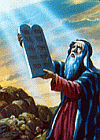 Moses is the one doing the reviewing. So he receives the tables.
|
 They were scared of the fire and of dying. Deuteronomy 5:25 "Now therefore, why should we die? For this great fire will consume us; if we hear the voice of the LORD our God anymore, then we shall die."
(NKJV)
They were scared of the fire and of dying. Deuteronomy 5:25 "Now therefore, why should we die? For this great fire will consume us; if we hear the voice of the LORD our God anymore, then we shall die."
(NKJV)
5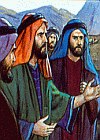 They wanted God to talk only to Moses.
|
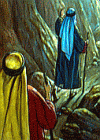 He would speak all commandments, statutes, and judgments that were to be taught the people beside the 10 commandments.
7 He spoke everything that was to be taught the people at this time.
|
 First of all, the Ten Commandments!
9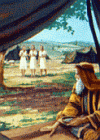 Love the stranger (implication is that orphans (fatherless) are included).
|
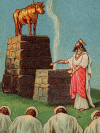 Destroy places of idolatry (in the promised land). No Christian has this mandate.
11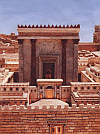 The place was later identified to be Jerusalem. So although Jerusalem was non-existent at this time, she indirectly becomes a part of the Ten Commandment covenant.
|
13 The covenant God commanded Moses to make with Israel while in the land of Moab. This was `beside` the Horeb (Sinai) covenant.
|
15 |
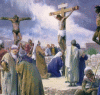 A future prophet was coming.
17 The people desired God to do it that way.
|
 God's Words.
19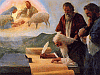 God makes His will known through visions and dreams to His prophets.
|
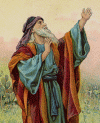 Whom does the prophet quote? The Lord God.
21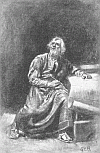 The writer and PROPHET Isaiah.
|
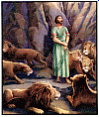 God did speak by these prophets.
23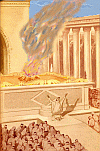 Offerings were required to take away sins.
|
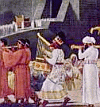 Instrumental music.
25 God's prophets spoke God's order on music.
|
 David was one of the main writers of the book of Psalms in the Bible. He was a prophet of God. God used his mouth.
27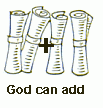 God could add as needed. Man could not.
|
28
Man could not `take away` or diminish from the covenant of God.
|
29
Man could not change God's Law by "adding".
|
30
Man could not change God's Law by subtracting from it.
|
31
In a book.
|
32
In a book.
|
33
He gave the Law to the priests and the elders.
|
34
In the side of the "ark of the covenant".
|
35
Moses was as god to Pharaoh; and Aaron was his prophet to Pharaoh.
This illustrates the meaning of the word "prophet" as God meant it.
|
36
A "prophet" is a `mouth` for his `god`. [Not that Moses was a god, but he was serving as a `god` in this context and relationship].
|